VZPP-S Voronezh — a supplier nexus to 58 sanctioned defence entities
On 22 June 2026, Ukraine struck the Voronezh Semiconductor Device Plant. The reporting covered what it feeds — components for the Kh-101 cruise missile, the Iskander-K, and the Pantsir air-defence system. What the strike itself does not show is the plant's position in the supply chain behind those systems.
Public Russian procurement records describe it. Between 2014 and 2018, JSC VZPP-S (INN 3661033635) is the supplier of record on 298 state contracts, worth about ₽1.19 billion, to 58 separately sanctioned defence entities — buyers that, resolved one by one, span Russian air-defence, cruise- and ballistic-missile, naval, electronic-warfare and nuclear-weapons programmes. It is an upstream node — one plant many others draw on — not a single production line.
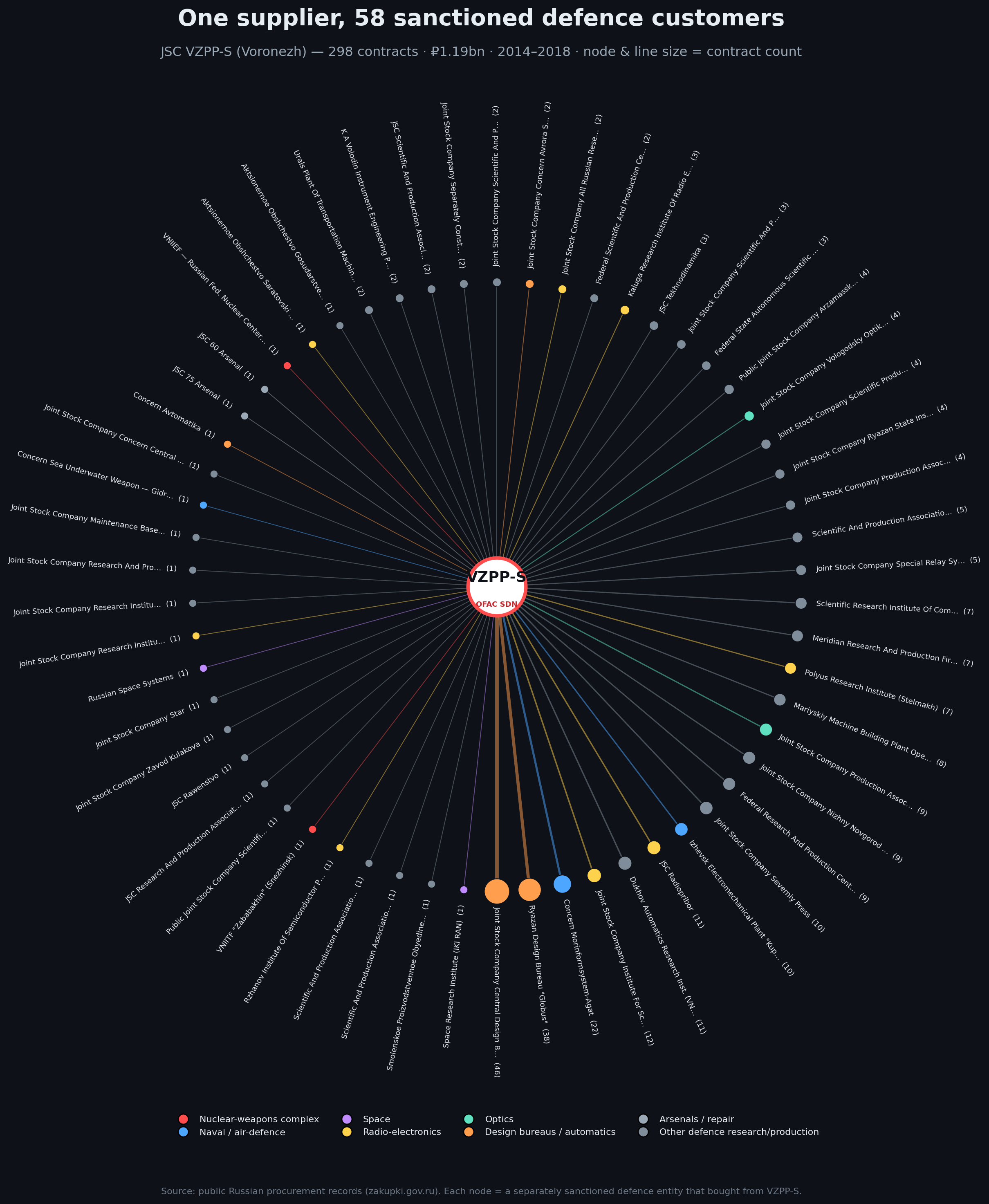
Among roughly 98,700 suppliers in that contracting data, VZPP-S ranks 47th by number of sanctioned customers — the top 0.05%. The heaviest single dependency is the Central Design Bureau of Automatics (46 contracts, about ₽260 million); the customer set spans design bureaus and automatics, radio-electronics and instrument makers, naval and air-defence concerns, space, and the nuclear-weapons complex. The convergence runs on the product side too: the Kh-101 and Iskander-K, the S-300V and Tor air-defence systems, the Oniks anti-ship missile and the nuclear-warhead complex all trace to the same supplier — set out by buyer in the section below.
Explore the interactive version — drag, zoom, and hover any node for the entity, its INN, sector, contract count, value, and date span.
VZPP-S has been on the US OFAC SDN list since 24 February 2023 (EO 14024, electronics sector); Japan and Australia followed later that year. Its public procurement trail ends in 2018 — not because the plant stopped, but because Russia classified the State Defence Order: on 28 December 2018, amendments to the law "On the State Defence Order" pulled defence contracting off the public register. The effect is visible across the whole dataset — of roughly 1,400 sanctioned suppliers traceable in the records, about 80% make their last public contract by the end of 2018. General procurement stayed visible until the broader wartime blackout after February 2022. What VZPP-S ships now is not in the open record; what the strike sets back depends on that, and on the damage.
What it shipped, and to whom
The contracts name the parts. By value, the 298 deliveries are microchips (₽466 million, 39%) and transistors (₽208 million, 18%); diodes, capacitors and bundled electronic components make up most of the remainder — about 97% microelectronics in all. Two contracts carry explicit defence markers: one booked under the State Defence Order, one at military acceptance grade "5".
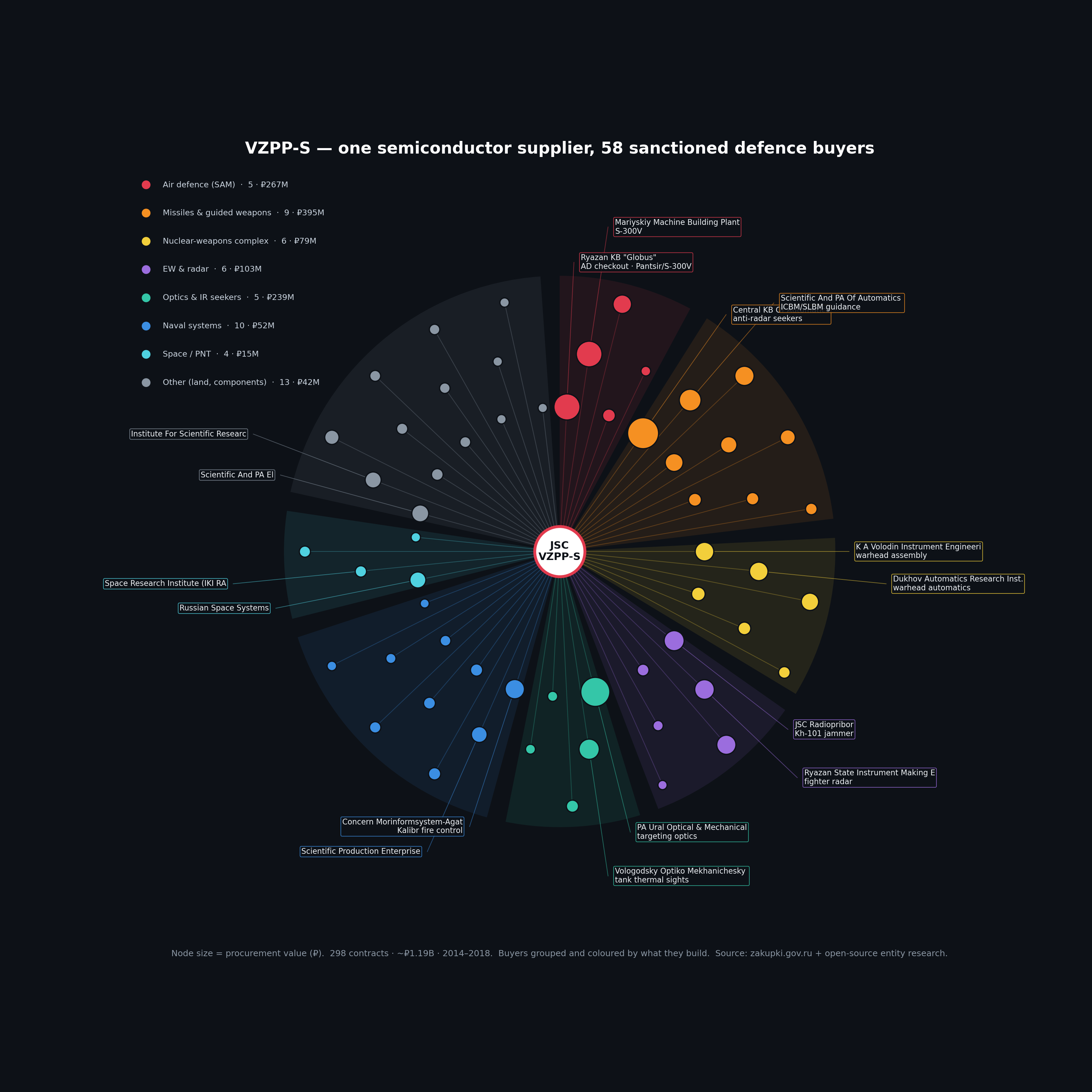
The buyers place those parts in context. All 58 resolve to Russian defence research and production entities, clustered on the systems behind the strike reporting:
- Air defence — Mari Machine-Building (S-300V) and Izhevsk "Kupol" (Tor), both Almaz-Antey, plus Ryazan KB "Globus", which builds the checkout stations for Buk, S-300V and the Pantsir-S1.
- Cruise and ballistic missiles — Radiopribor in Kazan makes the SP-504 jammer carried on the Kh-101, and Special Relay Systems supplies relays for the Kh-101 and Kh-59; VNII "Signal" builds guidance for the Pantsir-S1 and the Iskander; NPO "Strela" makes the Oniks/Yakhont anti-ship missile; and TsKBA — the largest single buyer at 46 contracts — builds passive anti-radar seeker heads.
- The nuclear-weapons complex — five separate sites: the Dukhov Institute (VNIIA) for warhead automatics, the K.A. Volodin plant for warhead final assembly, the Sarov (VNIIEF) and Snezhinsk (VNIITF) design labs, and NPO "Impuls" for Strategic Rocket Forces command-and-control.
- Naval systems, electronic warfare and seekers — Concern Morinformsystem-Agat (Kalibr fire control), Salyut (naval radars) and Gidropribor (torpedoes); NPO "Kvant" and the Kaluga radio-engineering institute (electronic warfare); and the Rzhanov Institute in Novosibirsk, which makes the infrared focal-plane detectors that go inside seeker heads.
One semiconductor plant sat upstream of all of it. The buyer attributions are open-source — OFAC and OpenSanctions listings, GUR war-sanctions records and company disclosures — over procurement traceable from 2014 to 2018.
The same-campus correction
Two legally separate companies share the 119A address — VZPP-S and VZPP-Mikron. Early reports named Mikron; the target was identified as VZPP-S, the entity on the sanctions list and the hub by every measure above. Same campus, different company.
Sources
- Strike, damage, casualties: The Moscow Times, Ukrainska Pravda
- Component / programme detail (Kh-101, Iskander-K, Pantsir): Kyiv Post, Militarnyi, Defense Express
- Target identification (VZPP-S vs Mikron): Euromaidan Press
- Designation: JSC Voronezhsky Factory Poluprovodnikovykh Priborov-Sborka, INN 3661033635 — OFAC SDN 24 Feb 2023, EO 14024; cross-ref OpenSanctions NK-jSjCPAFc3rcg2JZe6zv6vT, US Federal Register Vol. 88 No. 38 (27 Feb 2023)
- Procurement figures (58 sanctioned customers / 298 contracts / ₽1.19bn, 2014–2018): public Russian contracting records, zakupki.gov.ru